

Description
Iron Phosphate Sealing Rinses
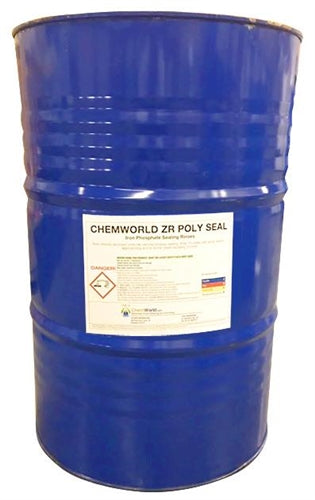
Nanotechnology Sealing Rinse for Outstanding Paint Adhesion and Corrosion Resistance on Steel, Galvanized, and Aluminum Substrates. Non-chrome zirconium polymer nanotechnology sealing rinse. Provides salt spray results approaching and in some cases equaling chrome. ChemWorld ZR Poly Seal is:- A clear nanotechnology coating formulated for both outstanding corrosion inhibition and superior paint adhesion on ferrous metals, aluminum, and galvanized substrates. The imperceptible coating contains a blend of organic and inorganic polymeric compounds which naturally and permanently bond with clean metal without changing the outward appearance and brightness of the substrate. In many cases, salt spray results and impact resistance can more than double over traditional non-chrome seals.
- Provides superior paint adhesion and corrosion resistance to the applied paint finish over traditional phosphoric or phos/moly non-chrome sealing rinses.
- Seeks out and fills any voids in the primary phosphate coating.
- Does not contain regulated heavy metals, and is acceptable for almost any waste treatment facility or regional POTW.
- An excellent replacement to traditional phosphorus based coatings when phosphates can not be used or discharged.
Concentration:
- Sealing of Phosphate Coating: Target: 1.0% by volume, Range: 0.5 – 2.0% by volume.
- Stand Alone Coating: Target: 2.0% by volume, Range: 1.0 – 2.5% by volume.
For technical recommendations, please email us at Tech@ChemWolrd.com.
- We are currently in the early stages of integrating this method of surface preparation into our powder coating process. As part of our process, we prepare materials through media blasting followed by powder coating. We are now exploring the most effective solution for applying ZR Polyseal on a larger scale. We have conducted small-scale testing using a garden pump sprayer, which proved successful.
Our next step is to develop a wash and rinse station that will allow us to apply the product efficiently to multiple items simultaneously. To date, we have considered several approaches, including the use of a "Connex box" where parts can be racked and sprayed in a manner similar to an automated car wash. We have also explored the possibility of dipping parts into a premixed chemical tank.
I am reaching out to request your recommendations or insight on the most effective, scalable solution for applying ZR Polyseal within a production environment. Any guidance you can provide would be greatly appreciated. - If you continue to media blast prior, and the surface of the metal is free of contaminants and media residue, either method will work (dip or spray) as long as the dust is pre-rinsed with clean water. If the enclosures contain media dust and other light contaminants, recirculating spray will be a better method, as the spray impingement will assist in removal of the ‘dust’ mentioned above.
Regardless of the chosen method, the parts must be free of residue to get the smoothness of finish that is required. The surface profile (from blasting) and the bond and corrosion control (from the ZR Polyseal) should yield extremely good results over just blasting.
Shipping and Transit Times
This product is made to order and ships within 3 to 5 business days from Punta Gorda, FL.
UPS Transit Map

Notes:
- This product only ships UPS.
- We can not ship FedEx or USPS.
- We can ship internationally.
- We can not ship this product to a PO box.
You will receive the tracking info after the order ships with 48 hours.
For expedited orders please email sales@buychemicalsdirect.com. We are fast at responding!
If you cannot order online, call in your order at (800) 658-7716 with specific directions.