


Description
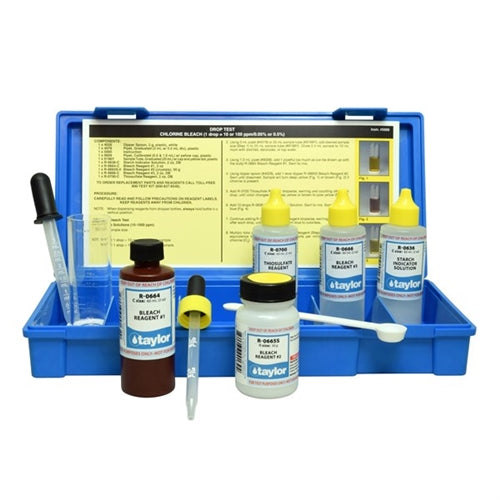
Taylor K-1579
ChemWorld is a distributor of Taylor Technologies Test Kits and Reagents. Order directly online and save today.DROP TEST CHLORINE BLEACH (1 drop = 10 or 100 ppm, 0.05 or 0.5%)
COMPONENTS: 1 x 4026 Dipper, plastic, large 1 x 4078 Pipet, Graduated, 3 mL (0.5 mL div.), plastic 1 x 5000 Instruction 1 x 9009 Pipet, Calibrated 0.5 & 1.0 mL, plastic w/yellow cap 1 x 9198Y Sample Tube, Graduated, 25 mL, plastic w/cap and yellow dot 1 x R-0636-C Starch Indicator Solution, 2 oz, DB 1 x R-0664-C Bleach Reagent #1, 2 oz 1 x R-0665S-II Bleach Reagent #2, 50 g 1 x R-0666-C Bleach Reagent #3, 2 oz, DB 1 x R-0700-C Thiosulfate Reagent, 2 oz, DB.
For Bleach Solutions of 10 to 1000 ppm
1. Select sample size.
For 1 drop = 10 ppm, 25 mL sample
For 1 drop = 100 ppm, 2.5 mL sample
2. Using a 3 mL pipet (#4078) or 25 mL sample tube (#9198Y), add desired sample size (Step 1) to 25 mL sample tube (#9198Y). Dilute 2.5 mL sample to 10 mL mark with distilled, deionized, or tap water.
3. Using a 1.0 mL pipet (#9009), add 1 pipetful (as much as can be drawn up with the bulb) R-0664 Bleach Reagent #1. Swirl to mix.
4. Using a large dipper (#4026), add 1 level dipper R-0665S Bleach Reagent #2. Swirl until dissolved. Sample will turn deep yellow or brown if chlorine is present.
5. Add R-0700 Thiosulfate Reagent dropwise, swirling and counting after each drop, until color changes from deep yellow or brown to pale yellow. Always hold bottle in vertical position.
6. Add 10 drops R-0636 Starch Indicator Solution. Swirl to mix. Sample should turn blue.
7. Continue adding R-0700 Thiosulfate Reagent dropwise, swirling and counting after each drop, until color changes from blue to colorless.
8. Multiply total drops of R-0700 Thiosulfate Reagent (Steps 5 and 7) by desired equivalence factor (Step 1). Record as parts per million (ppm) available chlorine.
For Bleach Solutions of 0.1 to 15%
1. Select sample size.
For 1 drop = 0.05%, 5 mL sample
For 1 drop = 0.5%, 0.5 mL sample
2. Using a 3 mL pipet (#4078), add desired sample size (Step 1) to 25 mL sample tube (#9198Y). Dilute to 10 mL mark with distilled, deionized, or tap water.
3. Using a 1.0 mL pipet (#9009), add 1 pipetful (as much as can be drawn up with the bulb) R-0664 Bleach Reagent #1. Swirl to mix.
4. Using a large dipper (#4026), add 1 level dipper R-0665S Bleach Reagent #2. Swirl until dissolved. Sample will turn deep yellow or brown if chlorine is present.
5. Add R-0666 Bleach Reagent #3 dropwise, swirling and counting after each drop, until color changes from deep yellow or brown to pale yellow. Always hold bottle in vertical position.
6. Add 10 drops R-0636 Starch Indicator Solution. Swirl to mix. Sample should turn blue.
7. Continue adding R-0666 Bleach Reagent #3 dropwise, swirling and counting after each drop, until color changes from blue to colorless. 8. Multiply total drops of R-0666 Bleach Reagent #3 (Steps 5 and 7) by desired equivalence factor (Step 1). Record as percent (%) available chlorine.
NOTE: Chlorine concentration is determined as grams per 100 mL (g/100 mL). For less concentrated solutions (less than 5%), this is approximately equal to percent (%). For concentrated solutions (equal to or greater than 5%), divide answer in Step 8 by the specific gravity. Record as actual percent available chlorine. For example: If 15% available chlorine is calculated in Step 8 and the specific gravity is 1.3, actual percent available chlorine is 11.5% by weight.
Shipping and Transit Times
This product is made to order and ships within 3 to 5 business days from Punta Gorda, FL.
UPS Transit Map

Notes:
- This product only ships UPS.
- We can not ship FedEx or USPS.
- We can ship internationally.
- We can not ship this product to a PO box.
You will receive the tracking info after the order ships with 48 hours.
For expedited orders please email sales@buychemicalsdirect.com. We are fast at responding!
If you cannot order online, call in your order at (800) 658-7716 with specific directions.